



Which AWD system gives you more real-world confidence near Brookfield, WI?
Russ Darrow Mazda of Greenfield – Which AWD system gives you more real-world confidence near Brookfield, WI?
AWD matters in southeastern Wisconsin, where daily commutes can swing from dry pavement to wet leaves, slush, or that first slick morning frost. When shoppers compare the 2026 Mazda CX-30 and the 2026 Hyundai Kona, a common question comes up right away: which AWD approach better supports everyday confidence without asking drivers to manage complexity? This deep dive unpacks how Mazda’s i-Activ AWD® and Hyundai’s HTRAC AWD distribute torque, anticipate traction changes, and integrate with their vehicles’ broader driving dynamics and drive modes.
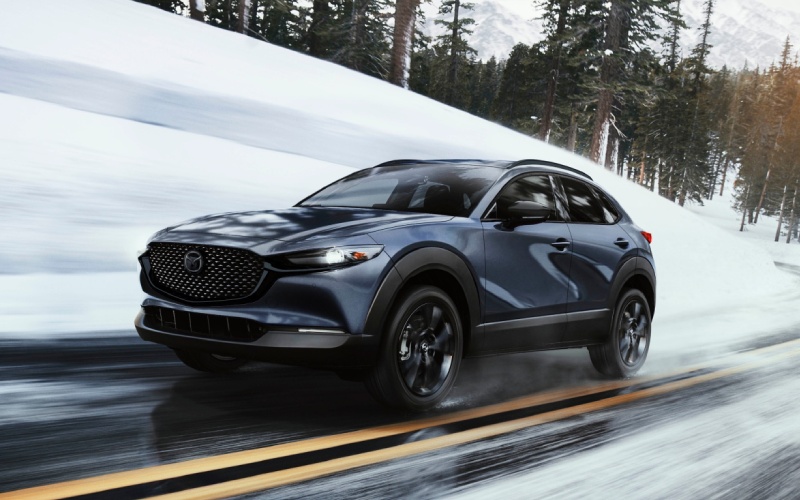
Mazda builds the CX-30 around standard i-Activ AWD® on every trim. That baseline matters because it eliminates the trim-shopping guesswork and ensures consistent capability across the lineup. i-Activ AWD® is a predictive system that continually evaluates wheel speed, steering angle, lateral acceleration, outside temperature, and more to allocate torque proactively. The benefit is felt most in transitions—turn-in on a damp corner, pulling away from a stop on painted lines, or cresting a patch of packed snow in a neighborhood roundabout. Complementing this is Mi-Drive with selectable modes, including an Off-Road setting that optimizes traction on loose surfaces. The result is a system that stays ahead of slip, rather than reacting after wheels start to spin.
Hyundai’s Kona offers available HTRAC AWD, and it does a commendable job sending torque rearward as conditions demand. In practice, HTRAC contributes reassuring stability and helps the Kona feel settled when the road surface changes or when you accelerate out of a side street onto a busy arterial. Kona’s drive modes also influence throttle and transmission behavior, and the calibration is friendly and confidence-inspiring for most drivers. The key distinction is availability—HTRAC AWD is optional, not standard—and the tuning philosophy, which leans more reactive. For many drivers, that’s sufficient; for those who want AWD integrated into every trim from day one, the Mazda approach has the edge.
Output matters too. The CX-30’s available SKYACTIV®-G 2.5 Turbo, rated up to 250 horsepower, pairs beautifully with i-Activ AWD® for confident highway merges and quick two-lane passes. Even the non-turbo 2.5L engine provides strong everyday response. Kona’s 1.6L turbo at up to 190 horsepower is energetic and pairs with an 8-speed automatic, and the base 2.0L focuses on smooth commuting. Yet in back-to-back drives, the Mazda’s broader torque plateau and transmission tuning deliver a more immediate, cohesive feel—especially beneficial when you need to slot into a short gap or climb a slick on-ramp.
Traction management is only as good as the supporting cast: steering, braking, and chassis calibration. Mazda applies G-Vectoring Control Plus to subtly shift load to the front axle on initial turn-in and then stabilize as you unwind. It’s nearly invisible to the driver, yet it helps the CX-30 track cleanly and reduces corrective inputs—less sawing at the wheel, fewer mid-corner adjustments. That harmony reduces fatigue on longer drives and pays dividends when surfaces are inconsistent. The Kona’s steering and chassis are tuned for comfort and light effort, with the Limited trim adding advanced camera-based features like Surround View Monitor to help with tight parking. Both vehicles can be equipped to ease daily stresses; Mazda distinguishes itself by how naturally each control interacts with the next.
Technology also plays a role in confidence. The CX-30 offers an available 360º View Monitor, front and rear parking sensors, and a windshield-projected Active Driving Display that keeps key info in your line of sight. Available Alexa Built-in adds convenient voice control for navigation, music, and smart-home functions so hands stay on the wheel and eyes stay on the road. Kona counters with wide-format displays, Bluelink+ connectivity, and available features such as Surround View Monitor and Remote Smart Parking Assist on Limited. Both cabins are modern and helpful; the Mazda’s restraint, material quality, and tactility deliver an upscale calm that supports focused driving in mixed conditions.
If you live near Brookfield, the commuting reality includes abrupt weather changes and variable pavement quality. That is exactly where standard i-Activ AWD® in the CX-30 shines—less decision paralysis at purchase, more traction in your back pocket every single drive. And because the Mazda system anticipates slip, the CX-30 tends to feel planted before the steering wheel even tugs or the traction light blinks. For drivers who want their compact SUV to quietly handle the background work, that difference is persuasive.
Before you decide, take a structured test drive that spotlights traction and control. A helpful route includes: a tight parking lot for low-speed maneuvering, a bumpy neighborhood loop to feel ride quality and noise isolation, an on-ramp merge to evaluate power and AWD logic, and a few lane changes on a busy boulevard to assess stability. Pay attention to how early each AWD system participates, whether the steering requires corrections, and whether the throttle-transmission handshake feels intuitive. These are the little things that define daily confidence more than a spec line alone ever could.
To sum up, both the 2026 Mazda CX-30 and the 2026 Hyundai Kona deliver impressive value and technology. If your top priority is confident, consistent traction and a drivetrain that anticipates rather than reacts, the CX-30’s standard i-Activ AWD® and available SKYACTIV®-G 2.5 Turbo provide the most complete package. If you prefer a tech-centric cabin aesthetic and plan to equip AWD selectively, the Kona remains a worthy contender. The best choice is the one that feels right in your hands and on your roads.
Russ Darrow Mazda of Greenfield, serving West Allis, Brookfield, and Menomonee Falls, invites you to compare these two side by side and feel how each system responds on the same route. Bring your questions, outline your daily drive, and ask for a route that mirrors it—this is the simplest way to make the confident call.
Frequently Asked Questions:
Is i-Activ AWD always on, and do I need to select a mode for snow?
i-Activ AWD® operates continuously in the background, monitoring conditions and proactively distributing torque. You can drive without selecting a special mode; for loose surfaces, the CX-30’s Mi-Drive Off-Road setting further optimizes traction.
How does Kona’s HTRAC AWD compare in everyday driving?
HTRAC AWD is available and reacts quickly to wheel slip, enhancing stability in changing conditions. It is effective and confidence-inspiring, though it is not standard across the Kona lineup.
Will I notice a difference in power between these two?
Yes. The CX-30’s available SKYACTIV®-G 2.5 Turbo—up to 250 hp—delivers stronger passing and merging than the Kona’s 190-hp 1.6L turbo. Even the Mazda’s non-turbo engine offers a robust baseline for daily driving.
Which features help most with low-speed confidence and parking?
Both offer a Surround View/360º camera on higher trims. The CX-30 adds available front and rear parking sensors and a windshield-projected Active Driving Display for better situational awareness right when you need it.
0 comment(s) so far on Which AWD system gives you more real-world confidence near Brookfield, WI?